

Start Vending Business with $0 Upfront. Click here
1-Year Warranty & Nationwide Support
Start Vending Business with $0 Upfront. Click here
1-Year Warranty & Nationwide Support
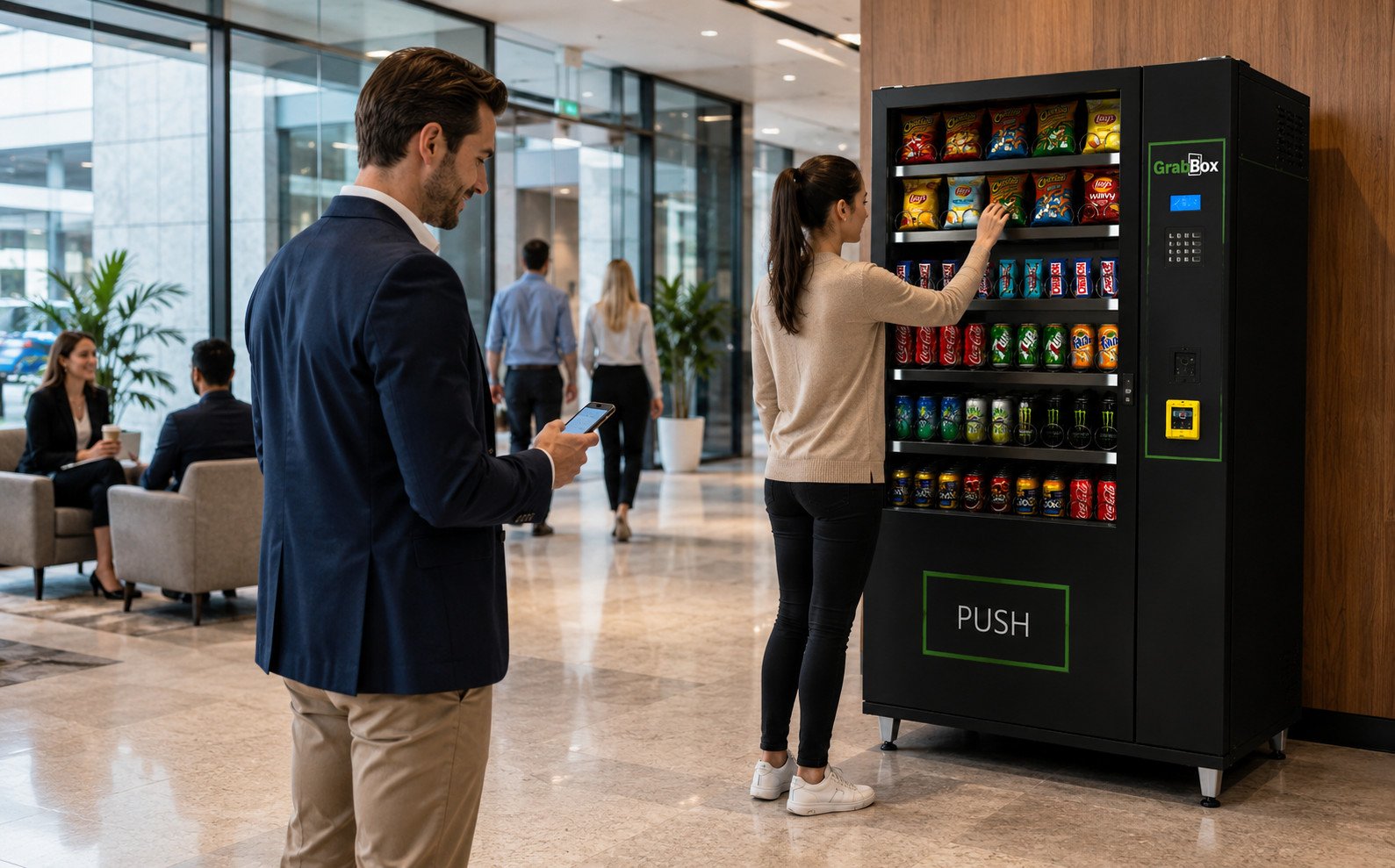
What if you could earn money while you sleep, while you are at work, and while you are on holiday — all from a machine the size of a large fridge?
That is the reality for thousands of Australians who have quietly built passive income streams through vending machines. No boss. No staff. No complicated business model. Just a machine in the right location, stocked with the right products, earning around the clock.
This is the story of how ordinary Australians are building vending machine income — and exactly how you can do the same.
When most Australians think about passive income, they think about property investment, shares, or online businesses. Vending machines rarely come up — and that is exactly why the opportunity still exists.
While everyone is competing for the same investment properties in the same suburbs and fighting over the same online business niches, a small group of quietly savvy Australians are placing vending machines in offices, gyms, warehouses, and hospitals — and collecting regular income with minimal ongoing effort.
The numbers are straightforward. A single vending machine in a good location can generate $400 to $2,000 per month in profit. A portfolio of ten machines can generate $4,000 to $20,000 per month. And unlike a rental property, you do not need a mortgage, a real estate agent, a property manager, or a bank’s permission to get started.
You need one machine, one location, and the willingness to restock it once a week.
Passive income is a term that gets thrown around a lot. Most so-called passive income businesses require significant ongoing work — creating content, managing customers, dealing with returns, answering emails at midnight.
Vending machines are different. Once a machine is placed and stocked, it operates completely independently. Here is what actually happens on a typical day for a vending machine operator.
None of these transactions required your involvement. Each one generated revenue that settled into your bank account while you were doing something else entirely.
That is what genuine passive income actually looks like.
Let us get specific. Here is what a realistic vending machine income looks like across different location types in Australia.
| Location | Daily Sales | Monthly Revenue | Monthly Profit | Break-Even |
|---|---|---|---|---|
| Small office — 30 staff | 15-25 transactions | $1,350-2,250 | $350-650 | 9-16 months |
| Medium office — 80 staff | 30-60 transactions | $2,700-5,400 | $750-1,600 | 4-8 months |
| Busy gym — 400 members | 50-90 transactions | $4,500-8,100 | $1,300-2,500 | 3-5 months |
| Warehouse — 60 workers | 45-80 transactions | $4,050-7,200 | $1,100-2,200 | 3-6 months |
| Hospital — common area | 60-100 transactions | $5,400-9,000 | $1,500-2,800 | 2-4 months |
Based on average transaction value of $3.50 and approximately 35% product margin after stock costs.
Even at the conservative end — a small office generating $350 per month profit — a single machine more than pays for itself within 16 months and then continues generating income indefinitely. At the strong end, a hospital machine breaking even in under four months is generating pure profit for years to come.
Here is where vending machines become genuinely exciting as a wealth-building tool.
Most successful vending operators do not fund their entire machine portfolio out of pocket. They start with one machine, let the income build up, and use that money to buy their second machine. Then their third. Then their fourth.
Here is what that growth can look like over three years.
| Timeline | Machines | Monthly Profit (est.) | Annual Income (est.) |
|---|---|---|---|
| Month 1 | 1 machine | $500-800 | $6,000-9,600 |
| Month 8-10 | 2 machines | $1,000-1,600 | $12,000-19,200 |
| Month 14-18 | 4 machines | $2,000-3,200 | $24,000-38,400 |
| Month 24-30 | 7 machines | $3,500-5,600 | $42,000-67,200 |
| Month 36 | 10 machines | $5,000-8,000 | $60,000-96,000 |
Ten well-placed machines generating an average of $500 to $800 profit each per month produces an annual income of $60,000 to $96,000. For most Australians, that replaces or significantly supplements a full-time salary.
And the total weekly time commitment for ten machines? Approximately 10 to 15 hours of restocking across the route.
Most vending machine failures come down to the same avoidable mistakes. Here is what separates operators who build genuinely profitable machines from those who do not.
This is the single biggest mistake new operators make. They buy a machine, get excited about the numbers, and then scramble to find somewhere to put it. A machine sitting in a garage earns nothing.
Successful operators identify and confirm their location first — getting written agreement from the property owner or manager — and then purchase their machine. The location comes first. Always.
Not all foot traffic is equal. A machine in a shopping centre common area with easy access to a food court will underperform the same machine in a warehouse where workers cannot leave the premises during breaks.
Captive audiences — people who cannot easily go elsewhere for food and drinks — are the foundation of a profitable vending machine. Warehouses, factories, office buildings with no nearby food options, gyms, and hospitals are captive audience locations. They consistently outperform general foot traffic sites.
The temptation to save money by buying a cheap imported machine or a used machine without compliance documentation is real. The consequences are not worth it.
In Australia, every vending machine operated in a commercial premises must carry the RCM mark — confirming it meets Australian Electrical Safety Standards. A non-compliant machine can void your insurance, create personal liability, and get removed from a site the moment a property manager asks for your compliance documentation.
Successful operators buy new, RCM-compliant machines from the start. The extra cost upfront is insignificant compared to the risk exposure of a non-compliant machine.
A cashless vending machine with a Nayax card reader records every transaction digitally. Successful operators use this data constantly — identifying top sellers, eliminating slow movers, adjusting prices, and spotting trends before they affect income.
Operators who ignore their data restock the same underperforming products week after week. Operators who use it keep their machines optimised and their income growing.
Vending machines are passive once they are running — but getting them to that point requires treating the setup phase like a real business.
Register your ABN, get public liability insurance, keep accurate records of income and expenses, and approach every location conversation professionally. Operators who take the business seriously from the start build better location relationships, secure better sites, and grow faster than those who treat it as a casual experiment.
The most common thing people say when they first hear about vending machine income is: “That sounds too simple. There must be a catch.”
There is not a catch — but there is a reality check.
Vending machines are not a get-rich-quick scheme. A single machine in a good location will generate a meaningful side income — not a fortune overnight. Building a genuinely significant income from vending requires multiple machines, good locations, and consistent reinvestment over one to three years.
But for Australians who are willing to put in the upfront work of finding good locations, invest in quality compliant machines, and commit to building their route over time — the compounding income effect is very real.
The people who fail at vending machines almost always share one of three characteristics — they bought a cheap non-compliant machine, they chose a poor location, or they gave up before the machine had time to recoup its cost and start generating meaningful profit.
If you are serious about starting a vending machine income in Australia, here is a practical 30-day action plan.
Week 1 — Research and location hunting
Week 2 — Approach locations
Week 3 — Purchase and prepare
Week 4 — Launch
By the end of your first month, your machine is earning. By month three, you have enough sales data to optimise your stock. By month six to twelve, you are looking for your second location.
Three trends are currently working in favour of Australian vending machine operators.
Cashless payments have removed the biggest friction point. For years, vending machines were limited by the need for exact change. A Nayax-equipped machine accepts every card and mobile wallet — which means every person who walks past your machine is a potential customer, not just the ones carrying coins.
Workplace return-to-office is driving demand. As Australian businesses bring staff back to offices after years of remote work, demand for workplace food and beverage amenities is rising. Offices that previously had empty break rooms are now looking for quick, low-cost ways to improve staff amenities — and a vending machine is the obvious solution.
The competition is still limited. Unlike property investment or share trading, vending machine income is not yet on most Australians’ radar as a legitimate wealth-building strategy. The operators who move now are securing the best locations before the market becomes crowded.
A single well-placed vending machine in Australia can generate $350 to $2,500 per month in profit depending on location quality and foot traffic. A portfolio of ten machines at good locations can generate $5,000 to $20,000 per month. Location quality is the primary driver of income.
You can start a vending machine passive income business in Australia for approximately $6,000 to $7,500 — covering the machine from $5,500, initial stock of $200 to $500, and basic public liability insurance. Finance options are available if you prefer to spread the cost.
Yes — once the machine is placed and running. The ongoing commitment is restocking, which typically takes one to two hours per machine per week. Everything else — transactions, payment processing, sales recording — happens automatically.
The GrabBox GB36-K4-C at $5,500 is the most popular starting machine for new Australian vending operators — RCM compliant, cashless payment ready, compact enough for most locations, and backed by a 1-Year Warranty. For high-traffic locations, the GB60-K4-C at $6,500 offers 300+ item capacity and a stronger income ceiling.
Break-even time depends on location quality. A machine at a strong location — a busy gym or warehouse — can break even in three to five months. A machine at a quieter location may take 12 to 18 months. After break-even, every dollar of profit is pure return on your initial investment.
Yes — and most operators do exactly this. Restocking takes one to two hours per machine per week. Most operators run five to ten machines alongside full-time employment before transitioning to vending as their primary income.
GrabBox supplies RCM-compliant, cashless-ready vending machines to new and experienced operators across Australia. Three models from $5,500. Australia-wide delivery. 1-Year Warranty. Local Australian support.
The machine that earns while you sleep starts here.



Be the first to hear about the latest offers and new machines.
Join hundreds of smart investors building passive income with Australia’s safest vending machines
Talk to a vending machine expert
Text us fast replies during business hours.
Live chat available now.